Tuesday, January 17, 2012

Too much of a good thing?

Earlier today, Robert Lane Greene at Johnson checked in from the road to ask readers what topics The Economist’s language blog should focus on. The replies so far are unusually varied (not just the same old peeves) and sometimes strange, but the strangest of all, I thought, came from Great Uncle Clive. His recommendation:
Not so many posts, Johnson . . . a max of two a week
Allow your bloggers* ... Us ... to respond to each other and develop ideas, before you change the topic
Thanx
A commenter who wants you to post less frequently: With fans like that, who needs critics? RLG is a pro, so I’m sure his response to Uncle Clive won’t be “If you want to develop your own %$@! ideas, write your own %$#@! blog!” But I wouldn’t be surprised if he was thinking it.
*I'm assuming (perhaps too charitably) that Uncle Clive's "blogger" for "commenter" here was a slip.

Wednesday, January 11, 2012

Impiousness nibblenips

Though Ron Paul finished well behind Romney in the New Hampshire primary, he was upbeat: "We're nibbling at his heels," he said.

I had never heard this variant on "nipping at one's heels," but it seemed so natural and plausible, I thought for sure it would be in the Eggcorn Database. But no; it's not there, and though the nibbling version gets a handful of Google hits, it doesn't come close to rivaling the standard nipping idiom.

That suits my sense of the words; I think of nipping (at someone's heels) as aggressive behavior, like herding sheep or chasing prey. Nibbling, on the other hand, means eating in tiny increments, or at least pretending to eat, and isn't a hostile act. The OED definition: "To take a small bite, or a series of small bites, at or from (a thing); to bite away gradually; to bite tentatively, delicately, playfully, or amorously."

There has been, historically, some overlap in the verbs' senses -- but not in the direction of the Ron Paul substitution. It's nip, which implies a a pinching action, that has sometimes been used as a synonym for nibble, according the the OED:
The milkcows were nipping the clovery parks (1839).
That durn brute was shakin' his ears and nippin' grass unconcerned as a can o' green corn. (1900)
Apparently, though, there have been moments when a writer felt the need of both verbs at once. And because one of those writers was George Meredith,* the OED has also recorded the "rare" word nibblenip, meaning, naturally, "to nibble and nip." The illustrative quote, from a poem of Meredith's (1883): "Haggard Wisdom, stately once, Leers fantastical and trips: Allegory drums the sconce, Impiousness nibblenips."

Maybe that's the word Ron Paul was looking for: "We're nibblenipping at his heels!" It does have a certain ring to it.

*The quoted lines will hardly recommend him, but Meredith wrote (among many other things) a comic-romantic-feminist novel every bit as deserving of a miniseries as "Jane Eyre" or "Sense and Sensibility." "Downton Abbey" is all very well, but every year I'm amazed that there's still no screen version of "The Egoist." 

Thursday, January 5, 2012

Open wide and say "aqueduct"

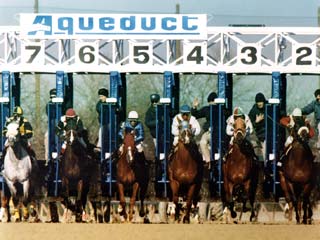
Listening to the news this morning, I heard an item about Gov. Andrew Cuomo's backing for a proposal to establish a casino at "the Aqueduct racetrack" in Queens. Pronounced AH-kwuh-duhkt,* with the of "father"  in the first syllable.

I nudged my husband, a New Yorker whose artist father used to supplement the family income by manning a parimutuel window in racing season. "How do you pronounce that racetrack?" I asked. "AK-kwi-duhkt,"* he said, using the a of "pat" and "sack."

That's how I say it, too -- and I'm a Midwesterner with no connection to racetracks beyond a typical history of girlhood horse-craziness.  But I don't think I would have noticed the AH pronunciation if the aqueducts in question had been Roman waterworks. Aqua, in my dialect, starts with AH, so aqueduct, when it isn't a racetrack name, could reasonably do the same.

But what do I know? According to Charles Harrington Elster, author of "The Big Book of Beastly Mispronunciations," all the AHs would be better as AKs. When he published the first edition of his book, in 1999, the only aqueduct pronunciation American dictionaries recognized was AK-kwi-duhkt, in his transcription, or ˈækwɪdʌkt (IPA, or so I hope as I type). 

By the time of his 2005 revised edition, he reports, things were changing. Some dictionary editors had been "seduced by the popular, broad-a variant." Not only that -- Encarta and the New Oxford American were listing the upstart first! Most dictionaries,  however, "continue to countenance only AK-kwi-duhkt, which has always been and still is the only cultivated pronunciation," he says.

Isn't it only natural for the AK of aqueduct to be gradually overpowered by  the much commoner AHK of aqua? That's no excuse, says Elster;  my AHK-wuh for aqua is just an earlier example of "uncultivated" pronunciation. It wormed its way into American dictionaries only in the 1930s, spread by people who had studied a little Latin and took to pronouncing aqua in what Elster calls a "faux-Latin" style. By this account, aqueduct is following aqua down the road to pronunciation hell.

Elster would like us to use AK (ack!) for all the initial-stress aqua words, which would certainly be neat. But just like those early-20th-century Latin students, we pick up words at different times and places, not in orderly family packs; we don't sort our pronunciations by etymology. I say aquaculture and aquatint with AH, and aquifer and aquiline with AK -- who knows why? A discussion of the question at Wordnik last summer showed I'm not alone:
I just realized that I use /æ/ for "aqueduct" but /ɑ/ for "aqua", which seems terribly inconsistent of me.
The classicist in me insists upon 'a' as in 'father' for both.  
Oh, weird -- I hadn't thought about it before, but if it's a Roman aqueduct, I'll say it with the "a" in "father," and if there are no Romans in the sentence, I'll say it with the "a" in "cat."
Maybe Americans will eventually give all the aqua words an initial AH soundwith New York's Aqueduct, as a proper name, holding out till the last. Or maybe not. If you feel like betting, $2 on Uncle Smokey in the seventh might be a safer play.


*Since I quote Charles Harrington Elster below, I've used his phonetic representations. 

Monday, January 2, 2012

Friendless in Fitbitland

A couple of months ago, I upgraded from a perfectly fine pedometer to Fitbit, which can track not only steps but also (it says) the quality of your sleep, synching it all to your Fitbit log. It works as advertised, but I've been letting it slide lately, with all the holiday distractions.

Could be the normal post-honeymoon crash, of course. Self-improvement plans can be fascinating for a few days -- me, it's all about me! -- but they tend to lose their luster as the real world comes back into focus. In this case, though, I think Fitbit's web folks have to share the blame. Whenever I log on to my "dashboard," I see this annoying personal message in the right margin of the page:

 Friends make Fitbit more fun

You don't have any friends yet.
Find friends. [link] 

"You don't have any friends." Seriously. I would understand (maybe) if Facebook nagged like this -- FB is all about friends, and I barely check in often enough to qualify as a lurker. But Fitbit's job is to help me keep moving, not prod me to bore my friends (yes, they exist) with daily exercise stats. 

No doubt there are crowds of Fitbit friends out there, spurring each other to ever higher mileage totals, and if it works for them, who could object? But Fitbit, it's bad manners and bad business to insult customers who prefer not to share. You don't want to be remembered as the guys who put the "bitter" in Fitbitter.

Friday, December 23, 2011

Happy meta-Festivus: Grieving the grievances

I’ve been trying to get a post off the ground for a while, but my topics were either too ambitious (no time!) or too peevish, and it just didn’t seem right to post minor gripes at The Most Wonderful Time of the Year. 

But hallelujah! This morning, both Fritinancy and You Don't Say reminded me that today is Festivus, a day that invites – nay, mandates – the airing of grievances. A few hours later, in a delightful cosmic conjunction, I came upon the perfect target for a Festivus grievance: Ron Rosenbaum’s essay today in Slate. The icing on the Festivus cake: The piece itself, though not labeled as such, is an Airing of (Language) Grievances. 

Yes, I have language grievances too – who doesn’t? – but Rosenbaum’s list is just the latest entry in a tired and exasperating genre: A catalogue of usages – in this case, allegedly faddish or newish ones – delivered along with the writer’s arbitrary judgments on whether they “deserve” to survive in the language. 

Often, as in this case, the writer offers half-baked theories for why some “losers” adopt the offensive words. Of the slang junk for genitals, for instance, Rosenbaum ventures that maybe “overdosing on junk-sex Internet porn has damaged the brains of so many men that they’ve come to think everything sexual is, well, junky.” 

That's a joke, I suppose, but there’s more:
Crowdsourcing: Hasn’t it occurred to anyone -- especially the new media genius types who abuse the concept -- that the archetypal crowd is a lynch mob?
Isn’t it obvious that someone who’s using gravitas is mainly trying to confer it upon himself by implying he has the gravitas to recognize and bestow gravitas?
It seems, despite my efforts, we will never be able to stamp out “spot on” and those who think the use of it gives them an Atlanticist sophistication.
But not all trendy words are unspeakable:
One new term I encountered on the website The Hairpin that sounds super-intriguing: napgasm. Apparently, it’s a thing. (That’s another of my fave catchphrases, by the way. It’s a thing is a thing.)
Meh: I still like this! I think it’s rare to find something so new and expressive in the language.
I could say more about his individual peeves and faves, but so could you, dear readers, so I won’t. We can all wonder together: What makes Rosenbaum think he gets to be the nation's "Catchphrase Executioner"?

But my grievance isn’t really directed at Rosenbaum; after all, he has a deadline to meet, and he's hardly the only writer to indulge the delusion that his rulings on language have weight. No, in this case I blame Slate. They’ve published Jesse Sheidlower and Ben Zimmer on language, so they know what reality-based usage analysis looks like. Editors sometimes save writers from their cheesier impulses; in this case they failed. So thank you, Slate, for inspiring a joyously cranky Festivus observance.  

Thursday, December 8, 2011

It's hard for I -- what about you?

Thanks to the diligence of my friend Betsy, I finally got around to seeing this year’s (pallid, underwritten) movie version of “Jane Eyre.” But though I wish Jane had been allotted more words, at least the meager script minimized the chance of language glitches. As it was, we were shocked to hear Jane, in the midst of a passionate speech, say to Rochester:
If God had blessed me with beauty and wealth, I could make it as hard for you to leave me as it is for I to leave you.
For I to leave you? Sure, we moderns often use object pronouns in compound nominatives (“Me and the dog are going out”) and vice versa (“an invitation for Sally and I”). But “as hard for I to leave” is much less common. Not unheard of -- Arnold Zwicky gave an example in an August post, and said there were more out there,  “too many to dismiss as nothing but inadvertent errors" -- but rare enough that I've never heard a complaint about it.

And Jane’s movie speech generally hews closely to the book, where she says 
if God had gifted me with some beauty and much wealth, I should have made it as hard for you to leave me, as it is now for me to leave you.
So someone (Moira Buffini is the scriptwriter of record) decided to “improve” Bronte’s dialogue, and nobody involved in the production ever said “Wait a minute, that doesn’t sound right.” O tempora, o mores, o BBC!

You may have noticed another word change there: Bronte’s “gifted me” becomes “blessed me” in the script, no doubt in deference to today's distaste for gift as a verb. Merriam-Webster’s Dictionary of English Usage points out that gift "make a present of" dates to the 17th century, though the context was generally institutional, as in "gifted to the Church of Rome."

As early as 1864, though, there were rumblings about it. In “The Queen’s English,” Henry Alford complained that adjectival gifted was “at present very much in vogue. Every man whose parts are to be praised, is a gifted author, speaker or preacher.” In 1909, Ambrose Bierce OK'd gifted but suggested that the verb itself was obsolete: Denouncing talented (vs. gifted), he noted, “These are both past participles, but there was once the verb to gift, whereas there was never the verb 'to talent.' If Nature did not talent a person the person is not talented."

But in the mid-20th century to gift spread to “a more mundane realm,” as Bryan Garner puts it, becoming a mere synonym for give: “He gifted her with a diamond bracelet.” This aroused the opposition, and the usage is still resisted as pretentious; Garner rates its acceptance at only stage 2 of a possible 5. So this edit of Bronte seems to be a reasonable effort to avoid raising viewers’ eyebrows. Unfortunately, changing “for me to leave” to “for I” is enough, all by itself, to raise eyebrows as high as they go -- for some of us, anyway.

Sunday, December 4, 2011

Grammar.net's latest cry for help

I suggested earlier this fall that winners of Grammar.net's Best Blog poll could use some help with proofreading, but apparently nobody stepped into the breach. After the contest, the site sent me (and 47 other nominees, I presume) a consolation prize -- "A gift for participation in the contest for the Best Grammar Blog of 2011." It's a badge to display on your blog, similar to the ones the top 3 winners were encouraged to post.

badge-top-50-grammar.net-2011.pngBut as usual, the best part of the e-mail was unintentional: "We would be happy to see you in the list of grammar bloggers in our contest for the Best Grammar Bog next time if we hold it again."

"Best Bog" has an especially nice ring for us Angela Thirkell fans, since one of the novelist's characters -- the post-WWII Mixo-Lydian Ambassadress to Britain -- is a woman of strong opinions whose favorite (often scornful) exclamation is "Bog!" Next time I hear from Grammar.net, that syllable will be my response.