Tuesday, September 25, 2012

I'll wager it's an eggcorn

Saw this line today in Eugenia Last's syndicated Astrological Forecast:
Wager the pros and cons of any situation before you decide to take part. 
I've only heard that expression as "weigh the pros and cons," "weigh your options," and so forth. But practically every day I learn that half the English-speaking world accepts a usage I've never heard, so I went to look for Google hits. There were only 104 (real) hits, many of them duplicates, and many from Eugenia Last forecasts (not always credited). Here's a recent one, from Sept. 15, 2012:
Don't jump at the first offer that comes your way. Wager the pros and cons of any decision you must make.
And the earliest one I found from Last, on Google News, from Sept. 2, 1997:
You will wager the pros and cons of any situation before you decide to jump in.
A sampling from the non-astrological cites:
One must wager the pros and cons of this feature. If this feature is of no importance then weight will be an issue.*
Thanks, I am getting more used to it as time goes by I guess I will have to wager the pros and cons.
"Wager the pros and cons" is a plausible enough eggcorn, it seems to me; instead of weighing the options, the metaphor involves making a mental bet on one's choice. But the usage doesn't seem to be spreading, even after 15 years of national exposure. ("Wager the options," which would be a natural extension of the idiom, gets only three Google hits.)  I don't know what the stars predict, but I doubt there's a bright future for this language innovation.

*Maybe this commenter used "wager the pros and cons" to avoid the echo of weigh/weight?

Update 10/20/12: Arnold Zwicky replies to my question about whether "wager the pros and cons" qualifies as an eggcorn.

Tuesday, September 18, 2012

Don't "quote" me

Michael Lewis's disclosure that he gave the White House "quote approval" for his new book on Obama has reignited the debate about the ethics of the practice. At Language Log, Mark Liberman weighs in, reminding us of the central fact that ought to be driving the discussion (but isn't): 
Most direct quotes in newspaper or magazine articles are approximate at best, representing a writer's reconstruction from fragmentary notes and from memory of what he or she thinks the source meant to say, as excerpted and adapted to the needs of the story. There's a spectrum of approximation, from accurate paraphrase though muddled and confused paraphrase to outright fabrication; but accurate quotation is the exception, not the rule. [Emphasis mine.] 
Mark has amply documented this sorry fact in earlier posts at Language Log (which he links to). But of course, many of us know it from experience. Here's Ann Blackerby, commenting on a post at the New York Times in which the new public editor addresses the question:
30 years ago, as a pediatric resident, I was called by a reporter from a respected daily paper to add to a story on ... a near-drowning case in which I'd been involved. The quotations published were made up out of whole cloth, but I was still rebuked by the director of the residency program. I wish I'd had veto power over my quotations then! 
Even David Carr, the Times journalist whose column yesterday denounced the granting of quote approval, seems concerned mainly with political and business sources -- those most likely to be in adversarial relationships with reporters. When that's not the case -- in science reporting, say -- is quote approval a problem, or just free expert advice?

I'm wondering, too, how Carr handles quotes in the real world. In an interview today on NPR's "Morning Edition," he described the traditional rules of journalistic engagement this way:
You ask them a question, they answer it, you write it down as carefully as you can, and should it be useful, you stick it in the newspaper.
"As carefully as you can," as Mark Liberman's work reveals, is often nowhere near carefully enough.

Saturday, September 15, 2012

Damned if I could stop negating ...

Ben Yagoda has a post at Lingua Franca responding to a reader who bristles at the phrase “one of the only.” He defends it as an idiom that we don't parse logically, like "can't help but think" and "could care less," but have no trouble understanding.

That's not good enough for truly devoted nitpickers, who continue to patiently explain that "I could care less" is a monstrous inversion of meaning. But the fact is, we accept flaws in logic much larger than this when we're engaged in reading or listening, rather than proofreading or peeving.

I was reminded of this by a story last month in the New York Times Magazine, in which Sarah Hepola described her struggles as an editor of confessional writing. Hepola wrote that she found herself "excising the grimmest parts of personal essays, torn between my desire to protect the human being and my knowledge that such unforgettable detail would boost a story’s click-through rate." Then came a paragraph with a couple of little speed bumps:
"This feels a little unprocessed," I told writers who shared their tales of date rape and eating disorders, but it was hard to deny that the internal chaos, that fog of confusion, could make for compelling reading, like dispatches from inside a siege. Yet "unprocessed" was exactly what [Cat] Marnell’s pieces were, and damned if I couldn’t stop devouring them.
That last clause is where I paused: "damned if I couldn’t stop devouring them.” The usual way to say what she means is "damned if I could stop,” which translates as “I couldn’t.” The idiom involves swearing to the truth of your report: In full, it's something like  “I’ll be damned (as a liar) if I (say I) could stop.” That is: "I couldn’t stop."

And that's not the only misnegation. Both sentences in Hepola's paragraph say the same thing, in essence: Personal train wreck tales are both repellent and riveting. But for some reason the word that connects them is "Yet," as if the second sentence somehow qualified or contradicted the first, when it actually supports it; taking out the "yet" is a clear improvement. (Did an editor insert it, I wonder?) 

But I'm not surprised that the wording passed unnoticed. By this point, a reader knows what Hepola's intending to say, and the "literal" reading would make no sense. As Mark Liberman and other Language Loggers have shown repeatedly, "our poor old monkey brains are not quite evolved enough" to handle such complexity; most of the time, we just take in the message we were meant to receive and ignore the logical glitches.
   
I’m not arguing that "getting the meaning across" is all that matters; if I thought that, I wouldn’t have become an editor. But monkey minds or not, we're smart enough to understand "one of the only people to have played in the NBA and for a major-league baseball team." Anyone interested in improving the language could easily find bigger fish to fry.

Tuesday, September 11, 2012

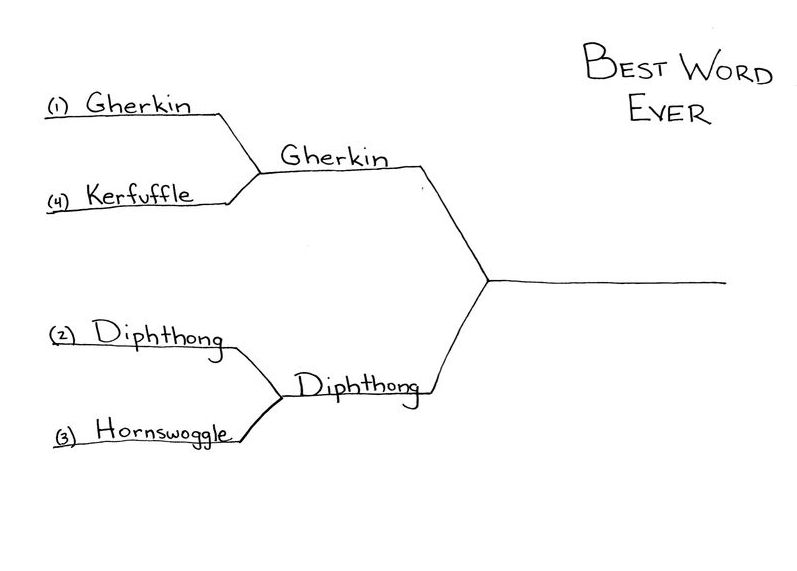
It's gherkin vs. diphthong


Arnold Zwicky recently sent readers to Ted McCagg’s blog, where a "Best Word Ever" competition has been unspooling for months, with words facing off in tournament-style showdowns. Today came the final pairing:

I had already been pondering the Final Four, posted yesterday, and was hoping that kerfuffle and hornswoggle would be kicked to the curb in this round. They're both fun words, as far as they go, but they're also invented words, intended (in some sense of the word) to be amusing. Hornswoggle is 20th-century American; kerfuffle is Scottish, a 20th-century variant of the 19th-century curfuffle, itself from a 16th-century verb, apparently onomatopoeic, meaning "to disorder, ruffle." And that's all there is. 

Both gherkin and diphthong have better stories, etymologically and otherwise. John Ayto's Dictionary of Word Origins gives this summary of gherkin's roots: 
Etymologically, a gherkin may be a 'little unripe one.' The word was borrowed from an assumed early Dutch *gurkkijn, a diminutive form of gurk, which probably came from Lithuanian agurkas. This in turn goes back via Polish ogurek to medieval Greek angourion, which has been linked with classical Greek agouros 'youth.' 
Diphthong, the term for two vowel sounds combined in one syllable, is also descended from Greek. And wouldn't it be nice to have a language word end up as Best Word Ever? But I think diphthong is only in the race because of its recent adoption as a slang insult, a development Neal Whitman explored a while back in a Visual Thesaurus piece. And that usage requires pronouncing the first syllable dip (as in dipstick, etc.), not as diff.

I don't mind that in theory; as Neal points out, "the spelling and pronunciation do have historical precedent: The word was borrowed from French, where it was originally spelled dyptongue, and the 'dip' pronunciation is recognized in several dictionaries." And it's pretty funny to see diphthong turned into a naughty word by kids who have no idea what it means. But if it wins the laurel,  which word is being honored? Is the insult dip(h)thong even the same word anymore, or just another funny coinage based on sound associations?

Gherkin has also had a small sideline as a rude word (what can you expect? It's a pickle and it  rhymes with jerkin'). But that use isn't widespread enough (at least in my world) to compete with the memory of gherkin as the sweet miniature pickles of childhood, the ones we liked when we couldn't yet stomach the dill spears. And gherkin is charming just as it is -- no variant pronunciation or nutty reinterpretation needed.

So I've got my fingers crossed for gherkin. But if diphthong carries the day, I'll be prepared. In a tournament where fuck was upset, a couple of rounds ago, by hornswoggle, we know anything can happen.

Sunday, August 26, 2012

Frozen yogurt with adjectives on top


Imagine you’re writing a description -- for a menu, say, or a shopping list -- specifying a certain sort of yogurt. The product is
Frozen
Made from Greek-style yogurt
Vanilla flavored
Fat free
How do you list those attributes?

Since I think of “frozen yogurt” as a permanent compound, like “ice cream,” I would probably start there. “Greek yogurt” is a common compound too, but if I say “frozen Greek yogurt” I could be talking about plain old Greek yogurt stuck in the freezer, and “frozen yogurt” is not the same thing as “yogurt, frozen.” So I go with “Greek frozen yogurt.” (Or maybe “Greek-style”?)

As I pondered the next step, I went back and reread Neal Whitman’s post on the ordering of adjectives, which was entertaining and smart, but didn’t do anything so mundane as tell me what to do with my remaining adjectives. It seemed like a toss-up: “Vanilla” and “fat-free” are just about equally relevant and weighty, though I guess you could argue that “fat-free” is a more fundamental property of the foodstuff in question. So: “Vanilla fat-free Greek frozen yogurt.”

And why am puzzling over this? Because a headline in the latest flyer from Trader Joe’s advertises “Frozen Vanilla Greek Fat Free Yogurt” -- a sequence I would never come up with.

And on another page, there’s “Greek Strawberry Vanilla Yogurt” -- this time with the “Greek” before the flavor -- which I would render as “Strawberry Vanilla Greek Yogurt.”

For non-TJ customers, I should note that the store flyers are quite well written and edited; these labeling oddities (if such they are) don’t reflect any lack of skill with the language, just a choice that sounds foreign to me.

And you, dear readers? Where did you put those adjectives?

Wednesday, August 22, 2012

Two good books

When I heard that Geoff Nunberg was writing a book about the word asshole, I thought it was a joke. But no -- days later, the mailman delivered a review copy of “Ascent of the A-Word,” subtitled “Assholism, the First Sixty Years.”

And yes, there is a book’s worth to say about this rude word, all of it entertaining. But since my annotated copy flew off in an airplane seat pocket the other day (there were extenuating circumstances -- children, diapers, seat swaps) I can’t share all the juicy quotes I marked. Luckily, others have liked the book as much as I did: See James Parker at the Barnes & Noble site, for instance, and John McIntyre’s blog post yesterday.

The finished copy has now arrived, so I can at least quote a couple of my favorite bits from the final chapter, on assholism in public life, where Nunberg zeroes in on one of the assholiest features of political discourse: fake outrage.
You’re acting like an asshole … if you accuse someone of incivility knowing full well that no neutral observer would interpret his behavior that way. Nobody for a moment hears any “violent rhetoric” when Obama says he’s itching for a fight with the Republicans or when Michele Bachmann describes Washington as “enemy lines.” The only purpose of a charge like that is to give your own partisans the enjoyment of imagining the irritation it will engender, all the more because it’s so transparently phony.
And then there's the fake outrageousness meant as bait for (real or fake) outrage. When journalist Westbrook Pegler maligned Jews as geese (“fouling everything in their wake”), says Nunberg, he was expressing genuine anti-Semitism. But "when [Ann] Coulter makes an analogous remark about Muslims, she’s only trying to sound offensive ... We know that she doesn’t lie awake seething about Muslims the way Pegler did about Jews.”

Fake offenses, fake responses -- what would Kant have said? That we should try to restrain ourselves, says Nunberg, out of respect for the dignity of the topic. But where's the fun in that?

While I'm in book-review mode, I also want to recommend a title published several months ago, on writing and the teaching of writing: "Vernacular Eloquence: What Speech Can Bring to Writing," by Peter Elbow. I haven't finished it, but like Language Hat, I don't to wait any longer to mention it, because whenever I dip into it there's something thought-provoking. On punctuation, say:
Punctuation is fascinating because it's where a certain kind of rubber hits a certain kind of road. It appeals to something deep in our relationship with language because it's the only visual cue that takes us from silent, timeless visual symbols on the page to audible, in-time, mouth-moving, performance in our bodies. It's where the mind meets the body, where the eyes meet the mouth, where space meets time.
Amazon offers a generous sampling of the book; see for yourself.

(FTC notice: The publishers of these books provided free review copies.) 


Thursday, August 9, 2012

Wedge issue

An item of pure language trivia, gleaned as I was catching up on my reading: The August 6 issue of The New Yorker uses the word wedge (in one form or another) six times, in five different stories.

Gallery listings, p. 11: “oddball arrangements of tomatoes, cheese wedges, and melons and balloons.”

Shouts & Murmurs, p. 33: “R.S.V.P. using the tiny card that is wedged somewhere between the fourth and seventh layers of tissue paper.”

Letter from Rangoon, p. 53: “Wedged like an arrowhead between India and China, Burma has been ruled by dictators …”

Ibid., p. 61: “all comically wedged into school chairs with plastic desks on the arms.”

The Theatre, p. 77: “Alcibiades … gets his wedge from Timon to pay for the soldiers.”

The Current Cinema, p. 78: “At an age when many men consider it a trial of strength to carry their own pitching wedge, [William Friedkin] still devotes himself to finding the optimum angle …”

That’s three uses of the past participle wedged and three of wedge the noun, in three different senses. Two of them -- the hunk of cheese and the golf club -- are familiar; the third, as I learned a couple of years ago, is British slang for money. The OED tells me it’s based on a “wad of bank notes” (a wedge, sort of, when folded in half) but no longer necessarily implies folding money.

This sense dates only to the 1970s, but wedge had two earlier careers in the financial field, one as "cant" for "silver, whether money or plate," in the 18th and 19th centuries, and another, much earlier, meaning "silver ingot," stretching back to the Venerable Bede. “The Old English wecg is in translations of Matt. xvii. 27 used for ‘piece of money, rendering Latin stater’” notes the OED.

How unlikely are the six wedges in one issue? It’s not worth going deep on the question of comparative frequency, but wedge has recently come up only once or twice a month in TNY. So it’s surely coincidental, just as a newspaper section will end up with five present-participle headlines, or toasters will pop up in several comics on the same day. (In fact, in yesterday’s Boston Globe three of the 30 comics used superhero jokes.)

The repetition would be hard for an editor to spot, and hard for most readers too, unless they  were reading several stories in succession. I wouldn't be surprised if someone else noticed the (mild) rash of wedges -- but I guess I wouldn't be surprised if nobody did, either.