Monday, October 29, 2012

Microsoft founder repurposes the semicolon

I was leafing through the November issue of WSJ. Magazine, wondering at the whimsies of the 1 percent, when I came upon some of the oddest semicolon usage I’ve ever seen. In a one-page feature called Still Life,* a photo of several possessions (detail below) is annotated by the objects’ proud owner -- in this case, Paul G. Allen, cofounder of Microsoft. A chunk of the text:
In 1999, I acquired Les Poseuses by Georges Seurat. I feel lucky to own a museum-quality masterpiece; I discovered Tomorrow, the Stars by Robert A. Heinlein in the basement as a boy -- it used to belong to my father. It's one of the many books that fueled my curiosity about the future of technology; a DEC tape containing the program files created by me and Bill Gates in Boston in 1975 while writing the BASIC code for the MITS Altair 8800. It was sent to Albuquerque, where we founded Microsoft; this Etruscan head was the first antiquity I've ever bought. People often don't realize that many early sculptures, like this one, were painted. The 2,500-year-old piece depicts a man with red hair; my biggest musical inspiration, Jimi Hendrix, used this Fender Stratocaster to play his iconic rendition of The Star Spangled Banner at Woodstock. ...
Yes, the clauses on the same topic are separated with periods, while the unrelated clauses are connected by semicolons -- the opposite of the usual practice. Maybe you don't find this disconcerting, but as one brought up on the standard semicolon -- the one that joins related clauses -- I was reeling. Once I caught on, I could see the potential: There's a certain weird poetry to "The 2,500-year-old piece depicts a man with red hair; my biggest musical inspiration, Jimi Hendrix, used this Fender Stratocaster." But is weird poetry what you use semicolons for?

Since the WSJ is generally a well-edited paper, I’m guessing this is Paul Allen’s own tic. And I can see his editor thinking, what the hell, it’s only 200 words, why annoy him? (I sometimes wish I’d said that to myself, as an editor, more often.) But those semicolons make it 200 words of extremely odd prose.

*It's STILL LIFE on the web version, but in print it's STILL/LIFE; I don't know how you'd parse that, but I'm sure someone thought it looked classy. 

Sunday, October 21, 2012

Muphry's Law across the pond

Earlier this month, the Financial Times ran a letter complaining about a couple of "grammatical" offenses, and once again the rule known as Muphry's/McKean's/Hartman's Law, or the Iron Law of Nitpicking, was in force: Any criticism of another's spelling or usage will itself contain at least one error.

This criticism came from faithful FT reader Brian Langdon-Pratt, who was in a state:
I'm shocked! Yes, really shocked! Reading the Financial Times last Friday -- as I’ve done for the past 40 years -- I came across two howlers. In the summary review by Nigel Andrews of The Perks of Being a Wallflower, he writes: “The hero Charlie wants to be ... even medalled as a social soldier”, and then later he compounds the grammatical offence by writing: "... half-brother Patrick is crash-coursed in literature". At least he put in a hyphen!
I know that standards of English grammar have slipped, but from Mr Andrews’ photo insert he looks old enough to know -- and hopefully to have been taught -- better.
The verb to medal has been around in the current sense since the 1960s, and Americans have complained about it for decades already. But as Graham at Linguism recently pointed out, medal is somewhat less familiar to the Brits, so if they want to smack it around a bit before they (inevitably) accept it, that's OK. The nonce coinage "crash-coursed," on the other hand, needs no defense -- the author isn't trying to impose it on the English-speaking world, he's just having a bit of fun.

But what about that "hopefully"? Does Langdon-Pratt not know that sentence-adverbial hopefully is (in Bryan Garner's terminology) a "skunked term" for true peevologists? I thought that perhaps hopefully aversion -- like our American which-that fetishism -- might have simply bypassed Britain. But according to Merriam-Webster's Dictionary of English Usage, "the ranks of hopefully haters grew steadily" in America from the mid-'60s to 1975, the year that "the issue seems to have crossed the Atlantic." British objectors, says MWDEU, "would repeat all the things American viewers with alarm had said, and add the charge of  'Americanism' to them."

You'd think a 40-year FT reader and language watcher would have encountered his culture's hopefully hostility at an impressionable age. But none of us can observe every language peeve, however attentive we may be -- hence the ubiquity, and inexorability, of Muphry's (etc.) Law.

Saturday, October 20, 2012

A canoedling detour, an eggcorn update

I've been neglecting this blog, it's true, but I haven't been utterly idle. I wrote a piece on the word canoodle for Cognoscenti, the new ideas-and-opinions blog at the website of my favorite public radio station, WBUR. And because canoodling has been linked (speculatively) with canoes, the (brief) history of boating romance is part of the background. It's a delightful story even without the language angle: Check out the essay "Love Boats" for more on "canoedling."

In other business: If your memory is good, you may recall that we debated, back in September, whether "wager the pros and cons" (instead of "weigh") qualified as an eggcorn. Arnold Zwicky, eggcorn eggspert, has replied to my request for a judgment on the matter:
Not an easy one. But you do make a semantic case for the eggcorn. [I.e., I argued that a speaker might think of "wagering" as betting on the likelihood of alternative outcomes.]
My guess is that this is a mixed case, with some occurrences being ordinary (classical) malaprops and some being eggcorns. (The phonology is a bit distant in either case.)
 It does seem unlikely that it's going to catch on.
So I guess Eugenia Last, the astrologer who's responsible for most examples of "wager the pros and cons," will get the last (sorry) word; if she means "wager" in some plausible way, she's got herself an eggcorn.

Illustration: A couple on the Charles River in Newton, Mass. (Vintage postcard courtesy of Benson Gray.)

Tuesday, September 25, 2012

I'll wager it's an eggcorn

Saw this line today in Eugenia Last's syndicated Astrological Forecast:
Wager the pros and cons of any situation before you decide to take part. 
I've only heard that expression as "weigh the pros and cons," "weigh your options," and so forth. But practically every day I learn that half the English-speaking world accepts a usage I've never heard, so I went to look for Google hits. There were only 104 (real) hits, many of them duplicates, and many from Eugenia Last forecasts (not always credited). Here's a recent one, from Sept. 15, 2012:
Don't jump at the first offer that comes your way. Wager the pros and cons of any decision you must make.
And the earliest one I found from Last, on Google News, from Sept. 2, 1997:
You will wager the pros and cons of any situation before you decide to jump in.
A sampling from the non-astrological cites:
One must wager the pros and cons of this feature. If this feature is of no importance then weight will be an issue.*
Thanks, I am getting more used to it as time goes by I guess I will have to wager the pros and cons.
"Wager the pros and cons" is a plausible enough eggcorn, it seems to me; instead of weighing the options, the metaphor involves making a mental bet on one's choice. But the usage doesn't seem to be spreading, even after 15 years of national exposure. ("Wager the options," which would be a natural extension of the idiom, gets only three Google hits.)  I don't know what the stars predict, but I doubt there's a bright future for this language innovation.

*Maybe this commenter used "wager the pros and cons" to avoid the echo of weigh/weight?

Update 10/20/12: Arnold Zwicky replies to my question about whether "wager the pros and cons" qualifies as an eggcorn.

Tuesday, September 18, 2012

Don't "quote" me

Michael Lewis's disclosure that he gave the White House "quote approval" for his new book on Obama has reignited the debate about the ethics of the practice. At Language Log, Mark Liberman weighs in, reminding us of the central fact that ought to be driving the discussion (but isn't): 
Most direct quotes in newspaper or magazine articles are approximate at best, representing a writer's reconstruction from fragmentary notes and from memory of what he or she thinks the source meant to say, as excerpted and adapted to the needs of the story. There's a spectrum of approximation, from accurate paraphrase though muddled and confused paraphrase to outright fabrication; but accurate quotation is the exception, not the rule. [Emphasis mine.] 
Mark has amply documented this sorry fact in earlier posts at Language Log (which he links to). But of course, many of us know it from experience. Here's Ann Blackerby, commenting on a post at the New York Times in which the new public editor addresses the question:
30 years ago, as a pediatric resident, I was called by a reporter from a respected daily paper to add to a story on ... a near-drowning case in which I'd been involved. The quotations published were made up out of whole cloth, but I was still rebuked by the director of the residency program. I wish I'd had veto power over my quotations then! 
Even David Carr, the Times journalist whose column yesterday denounced the granting of quote approval, seems concerned mainly with political and business sources -- those most likely to be in adversarial relationships with reporters. When that's not the case -- in science reporting, say -- is quote approval a problem, or just free expert advice?

I'm wondering, too, how Carr handles quotes in the real world. In an interview today on NPR's "Morning Edition," he described the traditional rules of journalistic engagement this way:
You ask them a question, they answer it, you write it down as carefully as you can, and should it be useful, you stick it in the newspaper.
"As carefully as you can," as Mark Liberman's work reveals, is often nowhere near carefully enough.

Saturday, September 15, 2012

Damned if I could stop negating ...

Ben Yagoda has a post at Lingua Franca responding to a reader who bristles at the phrase “one of the only.” He defends it as an idiom that we don't parse logically, like "can't help but think" and "could care less," but have no trouble understanding.

That's not good enough for truly devoted nitpickers, who continue to patiently explain that "I could care less" is a monstrous inversion of meaning. But the fact is, we accept flaws in logic much larger than this when we're engaged in reading or listening, rather than proofreading or peeving.

I was reminded of this by a story last month in the New York Times Magazine, in which Sarah Hepola described her struggles as an editor of confessional writing. Hepola wrote that she found herself "excising the grimmest parts of personal essays, torn between my desire to protect the human being and my knowledge that such unforgettable detail would boost a story’s click-through rate." Then came a paragraph with a couple of little speed bumps:
"This feels a little unprocessed," I told writers who shared their tales of date rape and eating disorders, but it was hard to deny that the internal chaos, that fog of confusion, could make for compelling reading, like dispatches from inside a siege. Yet "unprocessed" was exactly what [Cat] Marnell’s pieces were, and damned if I couldn’t stop devouring them.
That last clause is where I paused: "damned if I couldn’t stop devouring them.” The usual way to say what she means is "damned if I could stop,” which translates as “I couldn’t.” The idiom involves swearing to the truth of your report: In full, it's something like  “I’ll be damned (as a liar) if I (say I) could stop.” That is: "I couldn’t stop."

And that's not the only misnegation. Both sentences in Hepola's paragraph say the same thing, in essence: Personal train wreck tales are both repellent and riveting. But for some reason the word that connects them is "Yet," as if the second sentence somehow qualified or contradicted the first, when it actually supports it; taking out the "yet" is a clear improvement. (Did an editor insert it, I wonder?) 

But I'm not surprised that the wording passed unnoticed. By this point, a reader knows what Hepola's intending to say, and the "literal" reading would make no sense. As Mark Liberman and other Language Loggers have shown repeatedly, "our poor old monkey brains are not quite evolved enough" to handle such complexity; most of the time, we just take in the message we were meant to receive and ignore the logical glitches.
   
I’m not arguing that "getting the meaning across" is all that matters; if I thought that, I wouldn’t have become an editor. But monkey minds or not, we're smart enough to understand "one of the only people to have played in the NBA and for a major-league baseball team." Anyone interested in improving the language could easily find bigger fish to fry.

Tuesday, September 11, 2012

It's gherkin vs. diphthong


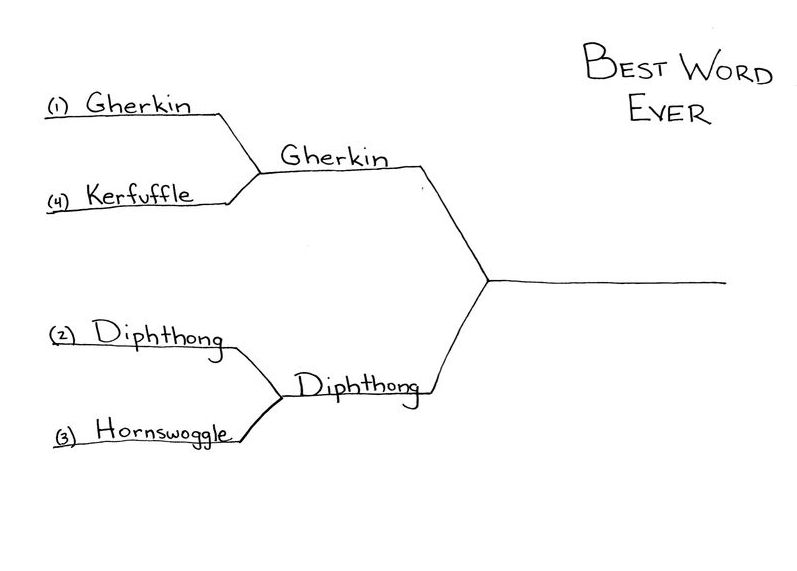
Arnold Zwicky recently sent readers to Ted McCagg’s blog, where a "Best Word Ever" competition has been unspooling for months, with words facing off in tournament-style showdowns. Today came the final pairing:

I had already been pondering the Final Four, posted yesterday, and was hoping that kerfuffle and hornswoggle would be kicked to the curb in this round. They're both fun words, as far as they go, but they're also invented words, intended (in some sense of the word) to be amusing. Hornswoggle is 20th-century American; kerfuffle is Scottish, a 20th-century variant of the 19th-century curfuffle, itself from a 16th-century verb, apparently onomatopoeic, meaning "to disorder, ruffle." And that's all there is. 

Both gherkin and diphthong have better stories, etymologically and otherwise. John Ayto's Dictionary of Word Origins gives this summary of gherkin's roots: 
Etymologically, a gherkin may be a 'little unripe one.' The word was borrowed from an assumed early Dutch *gurkkijn, a diminutive form of gurk, which probably came from Lithuanian agurkas. This in turn goes back via Polish ogurek to medieval Greek angourion, which has been linked with classical Greek agouros 'youth.' 
Diphthong, the term for two vowel sounds combined in one syllable, is also descended from Greek. And wouldn't it be nice to have a language word end up as Best Word Ever? But I think diphthong is only in the race because of its recent adoption as a slang insult, a development Neal Whitman explored a while back in a Visual Thesaurus piece. And that usage requires pronouncing the first syllable dip (as in dipstick, etc.), not as diff.

I don't mind that in theory; as Neal points out, "the spelling and pronunciation do have historical precedent: The word was borrowed from French, where it was originally spelled dyptongue, and the 'dip' pronunciation is recognized in several dictionaries." And it's pretty funny to see diphthong turned into a naughty word by kids who have no idea what it means. But if it wins the laurel,  which word is being honored? Is the insult dip(h)thong even the same word anymore, or just another funny coinage based on sound associations?

Gherkin has also had a small sideline as a rude word (what can you expect? It's a pickle and it  rhymes with jerkin'). But that use isn't widespread enough (at least in my world) to compete with the memory of gherkin as the sweet miniature pickles of childhood, the ones we liked when we couldn't yet stomach the dill spears. And gherkin is charming just as it is -- no variant pronunciation or nutty reinterpretation needed.

So I've got my fingers crossed for gherkin. But if diphthong carries the day, I'll be prepared. In a tournament where fuck was upset, a couple of rounds ago, by hornswoggle, we know anything can happen.